When BIM Stops at Handover, We All Lose
The real challenge of BIM for FM isn’t modelling — it’s information continuity. Here’s what it takes to make BIM deliver value long after construction ends.
Facility Management is no longer just about maintaining assets. It’s about managing information, performance, and lifecycle value. In Singapore and across the region, the shift toward BIM-enabled FM is quietly redefining how we think about the operational phase of buildings — but the industry still has a significant gap to close.
The Real Problem Isn’t the Model
Ask most FM teams what they think of BIM, and you’ll hear one consistent frustration: by the time they take over a building, the model is already outdated, incomplete, or structured in ways that make it almost useless for day-to-day operations.
The issue isn’t the technology. It isn’t the software. The challenge is information continuity — the idea that the rich data created during design and construction must survive handover in a form that operations teams can actually use.
Too often, a BIM model is a construction artefact. It answers the questions of the design team. It does not answer the questions of the FM team: Where is this asset? When was it last serviced? What is its expected replacement date? Who is the maintenance contractor?
“BIM for FM only works when data survives handover, information is structured for operations, and systems speak to each other.”
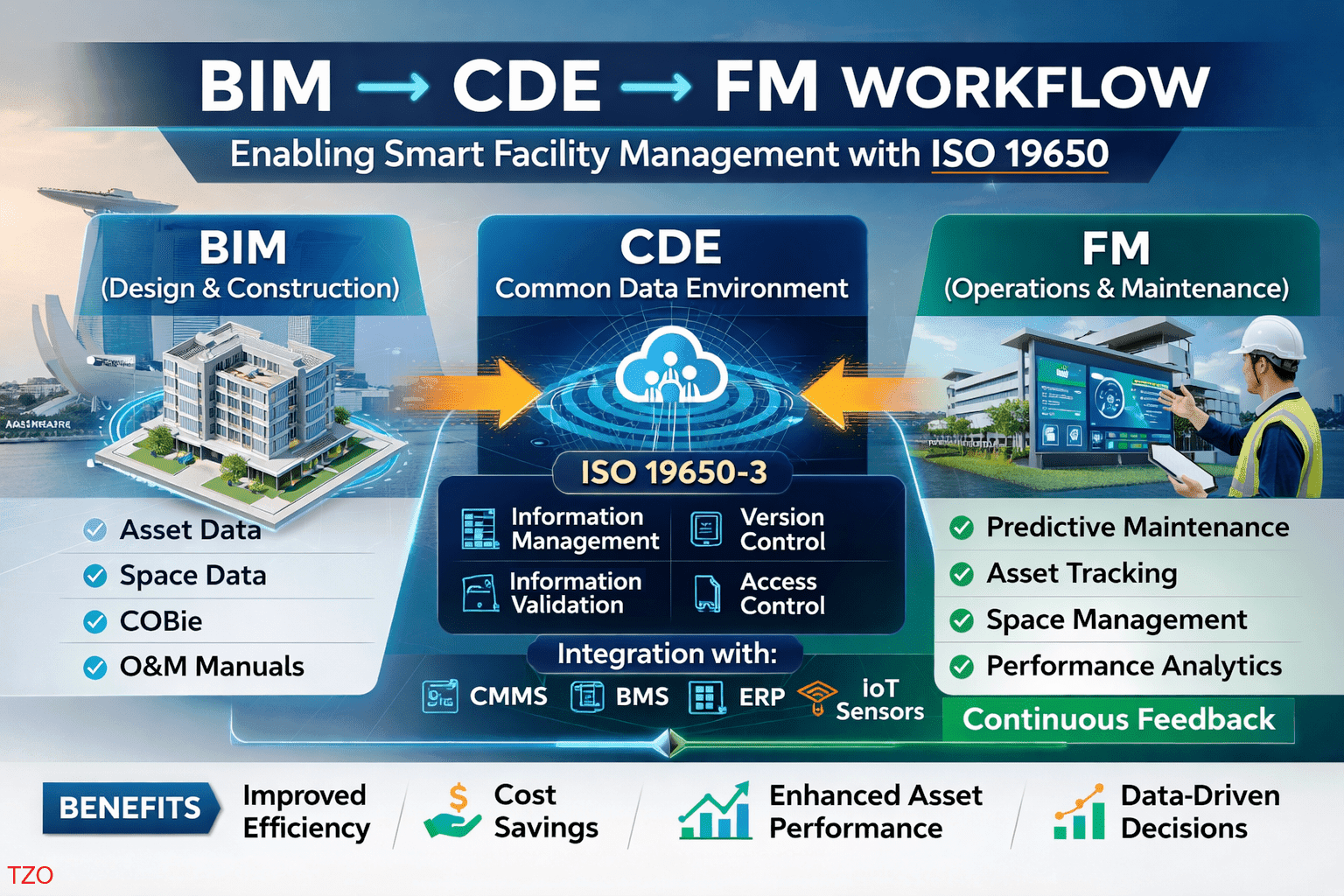
The BIM → CDE → FM Workflow
The solution lies in understanding the full information workflow — from design and construction, through a Common Data Environment, and into the operational systems used by FM teams. This is not a linear hand-off. It is a continuous, governed information pipeline.
- Asset Data
- Space Data
- COBie Output
- O&M Manuals
- Information Mgmt
- Version Control
- Validation
- Access Control
- Predictive Maint.
- Asset Tracking
- Space Mgmt
- Performance Analytics
The CDE Is Not Just a File Server
This is perhaps the most misunderstood aspect of modern information management. A Common Data Environment — done properly — is not a storage platform. It is not a cloud folder with better naming conventions.
A CDE is an information governance strategy. It is the connective tissue between the design world and the operations world. It ensures that information is validated, versioned, access-controlled, and structured in a way that downstream systems — CMMS, BMS, ERP, IoT sensors — can consume it reliably.
This is precisely where ISO 19650-3 becomes important. The standard focuses specifically on the operational phase of assets, providing a framework for how information should be managed throughout a building’s life — not just during construction.
The Building and Construction Authority (BCA) of Singapore reinforces this through its Guide to Smart FM, articulating a simple but powerful idea: Smart FM is driven by structured, reliable, and accessible data. Not technology first. Information first.
- Data must survive the handover process intact and in a usable structure
- Information must be organised for operational use, not just design review
- FM systems (CMMS, BMS, ERP, IoT) must be able to consume and exchange this data
Why This Matters: The Lifecycle Opportunity
Buildings spend roughly 10–20% of their lifecycle in design and construction. The remaining 80–90% is operations. Yet this is where the least structured information management exists in most organisations.
The opportunity cost is significant. When BIM-enabled FM is implemented correctly — with proper information governance, structured asset data, and integrated systems — the results are measurable.
FM teams spend less time hunting for information and more time acting on it. Work orders are generated from accurate asset data, not guesswork.
Predictive maintenance strategies replace reactive ones. Knowing asset condition and history enables smarter replacement and servicing decisions.
When IoT sensor data is linked to BIM asset records, performance insights emerge that are simply not possible with disconnected systems.
Capital planning, lease management, space utilisation — all improve when decisions are grounded in reliable, structured data from the CDE.
The Shift That Needs to Happen
The industry conversation about BIM has long centred on design coordination and clash detection. These are valuable. But they represent only a fraction of the value that BIM can deliver over a building’s full lifecycle.
The shift needs to be toward thinking of BIM as an information management discipline — one that starts at design, but is ultimately in service of the people who operate and maintain buildings for decades.
In Singapore, the regulatory environment, the BCA’s guidance, and growing owner awareness are creating the conditions for this shift. The question for practitioners, consultants, and technology providers is whether we are ready to meet that moment.
“Smart FM is driven by structured, reliable, and accessible data. Not just technology. Not just software. Information management.”
— Aligned with BCA Guide to Smart FM & ISO 19650-3The model is not the end goal. The information it carries — and where that information goes next — is what determines whether BIM truly delivers on its promise.