
When BIM Stops at Handover, We All Lose
The real challenge of BIM for FM isn’t modelling; it’s information continuity. Here’s what it takes to make BIM deliver value long after construction ends.
By Tun Zaw Oo · MEP BIM Coordinator (Fire Protection) · ISO 19650-2 PIM Practitioner (BRE Global)
Facility management is no longer just about maintaining assets. It is about managing information, performance and lifecycle value. In Singapore, the UK and elsewhere, the move towards BIM-enabled FM is changing how we think about the operational phase of buildings, but the industry still has a significant gap to close.
The real problem isn’t the model
Ask most FM teams what they think of BIM and you’ll hear the same frustration: by the time they take over a building, the model is outdated, incomplete, or structured in a way that makes it almost useless for day-to-day operations.
The problem isn’t the technology or the software. It is information continuity: the data created during design and construction must survive handover in a form operations teams can actually use.
Too often a BIM model is a construction artefact. It answers the design team’s questions, not the FM team’s: Where is this asset? When was it installed? Who supplied it? When does the warranty end?
BIM for FM only works when data survives handover, information is structured for operations, and systems can exchange data with each other.
The BIM → CDE → FM workflow
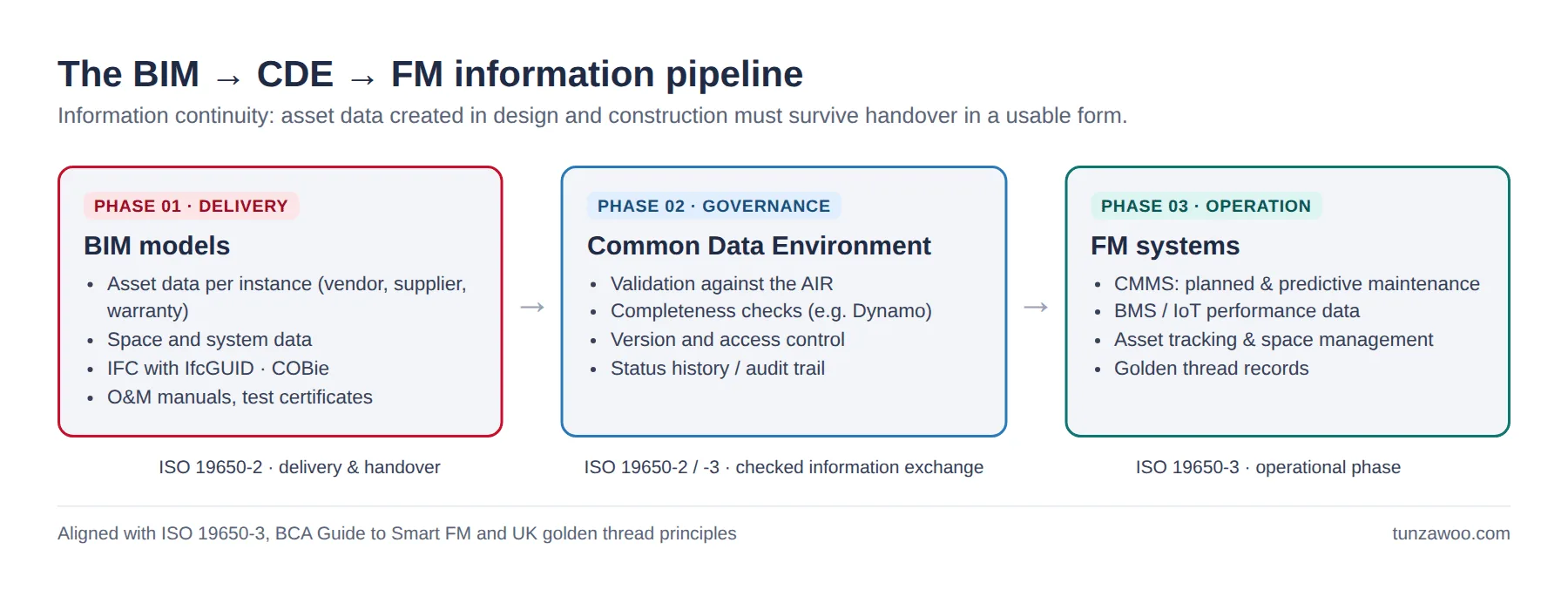
The solution is to manage the full information pipeline, from the design and construction models, through a Common Data Environment, into the systems FM teams use. This is not a one-off hand-off but a continuous, governed flow.
| Phase 01: BIM (design & construction) | Phase 02: CDE (ISO 19650) | Phase 03: FM systems |
|---|---|---|
| Asset data | Information management | Planned & predictive maintenance |
| Space data | Version control | Asset tracking |
| COBie / IFC output | Validation | Space management |
| O&M manuals | Access control | Performance analytics |
The CDE is not just a file server
A properly run Common Data Environment is not a cloud folder with better naming conventions. It is an information governance strategy, supported by technology. It makes sure information is validated, version-controlled, access-controlled and structured so that downstream systems (CMMS, BMS, ERP, IoT platforms) can rely on it.
This is where ISO 19650-3:2020 matters. It covers the operational phase of assets and how information is managed throughout a building’s life, not only during construction.
In Singapore, the Building and Construction Authority’s Guide to Smart FM makes the same point: smart facility management depends on structured, reliable and accessible data. Information comes first, technology second.
In the UK, the same principles appear in the UK BIM Framework guidance on ISO 19650-3, in COBie handover, and in BSRIA and Government Soft Landings, which bring operators in before handover. For higher-risk buildings, the Building Safety Act 2022 requires a “golden thread” of accurate, up-to-date building information for the building’s whole life.
Three conditions for BIM-FM to actually work
- Data must survive the handover process intact and in a usable structure
- Information must be organised for operational use, not just design review
- FM systems (CMMS, BMS, ERP, IoT) must be able to consume and exchange this data
From my projects: building FM-ready data into the model
Information continuity starts long before handover, in the task team’s model. As a fire protection BIM coordinator, these are the practices I use to make sure our data is still useful when the building is running.
1. Asset data defined per instance, not per family
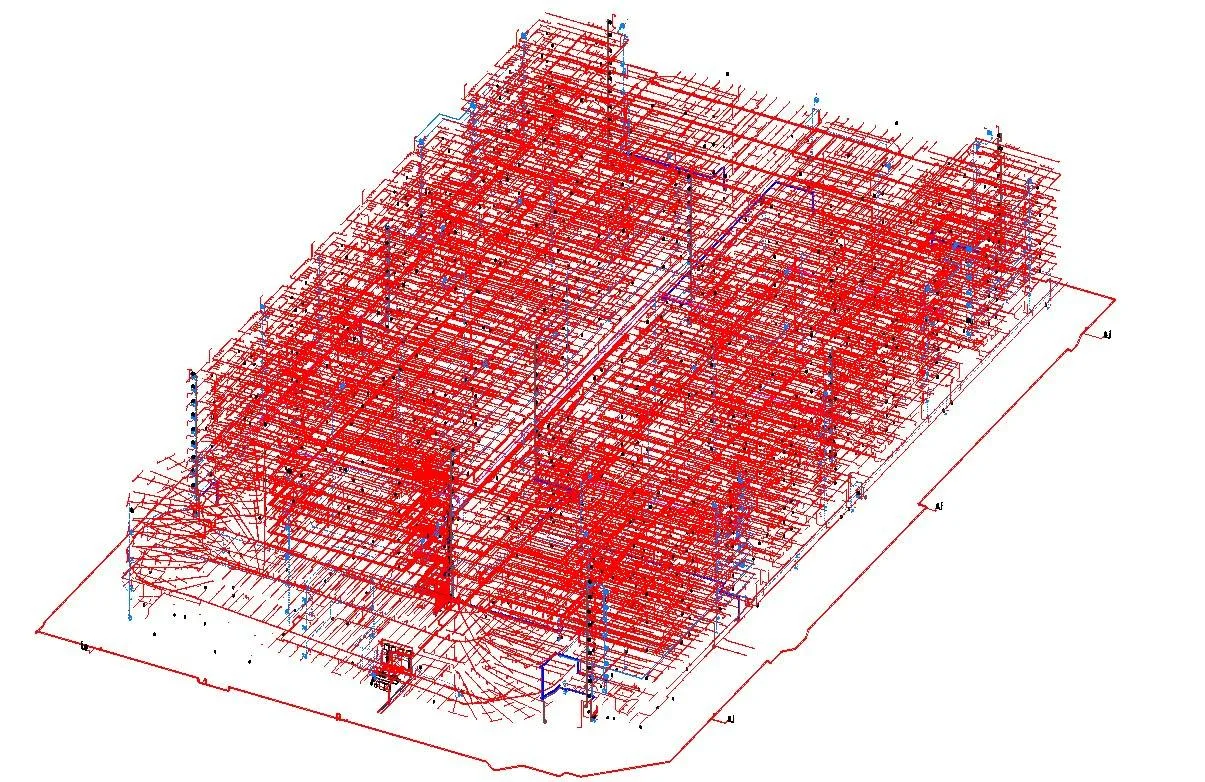
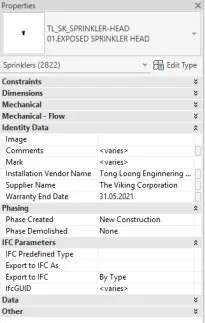
On a six-storey multi-user food factory in Singapore (135 factory units, 5 mezzanine levels), the fire protection model contained 24,546 sprinkler heads. FM parameters (installation vendor, supplier and warranty end date) were populated for every sprinkler instance, and the model was exported to IFC with IfcGUIDs so each asset keeps a stable identity in downstream systems.
2. Completeness checked automatically, before sharing
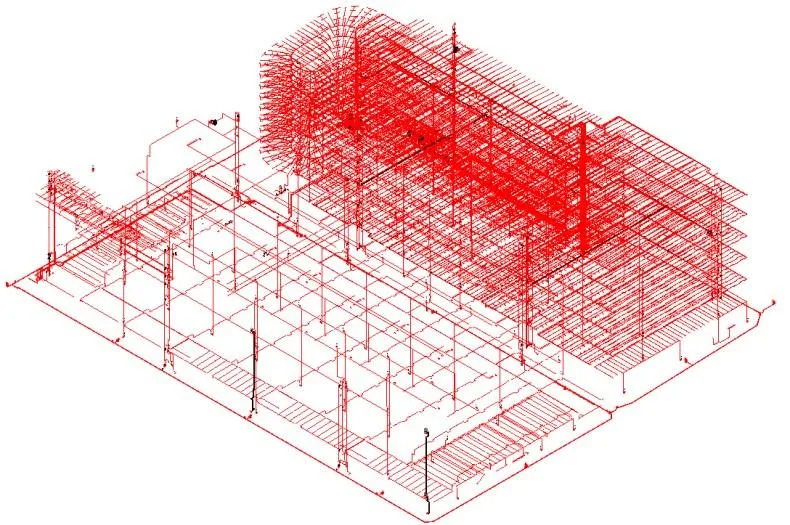
Blank fields are the most common reason FM data fails. I use a Dynamo missing-parameter checker to audit asset data before a model is shared. On one model it checked 16,276 sprinklers in a single run and exported 29 missing installation dates and 18 missing K-factors to Excel for correction. On a six-storey ramp-up warehouse, asset data on 15,007 ESFR sprinklers was checked the same way.
3. Gaps caught in WIP, not at handover
On an ISO 19650-2 project (Parry Avenue Assisted Living Apartment), our BEP validation checklist found missing installation-status data on Level 2 sprinklers. It was corrected before the model was resubmitted to Shared. Found at handover, the same gap would have meant a site survey.
4. Engineering knowledge behind the data
Asset data only means something if the person defining it understands the system. With 15+ years in fire protection engineering, I know which attributes an operator needs for sprinklers, pumps, risers and hydrants, and I can tell when a value is technically wrong, not just missing.
Why this matters: the lifecycle opportunity
Design and construction typically take a few years; a building may operate for 50 years or more. Measured in time, well over 80% of a building’s life is spent in operation, and that is also where much of its whole-life cost is incurred. Yet it is where most organisations have the least structured information management.
Improved operational efficiency
FM teams spend less time hunting for information and more time acting on it. Work orders are based on accurate asset data, not guesswork.
Reduced lifecycle costs
Planned and predictive maintenance replaces reactive repair, and known asset history supports better replacement decisions.
Enhanced asset performance
Linking IoT and BMS data to BIM asset records reveals performance insights that disconnected systems cannot provide.
Safer buildings
Fire protection systems are life-safety assets. Accurate records of what was installed, where and when support inspection, testing and maintenance regimes, and the golden thread.
The shift that needs to happen
The industry conversation about BIM has long centred on design coordination and clash detection. These are valuable, but they are only part of the value BIM can deliver.
The shift needed is to treat BIM as an information management discipline: one that starts in design but ultimately serves the people who operate and maintain buildings for decades. And it is not only the client’s job. Every task team decides, element by element, whether its information will survive handover.
Smart FM is driven by structured, reliable and accessible data. Not just technology. Not just software. Information management.
The model is not the end goal. The information it carries, and where that information goes next, determines whether BIM delivers on its promise.
Glossary
- CDE: Common Data Environment, the agreed source of information for managing, sharing and validating information
- COBie: Construction Operations Building information exchange, a data schema for handing over asset and space data
- IfcGUID: a globally unique identifier that keeps an element’s identity consistent across software
- CMMS: Computerised Maintenance Management System, used to track work orders, assets and maintenance
- BMS: Building Management System, which monitors and controls building services
Reference standards and guidance
- ISO 19650-3:2020: Information management using BIM, operational phase of assets
- BCA Guide to Smart FM: Building and Construction Authority, Singapore
- UK BIM Framework: guidance on implementing ISO 19650 in the UK
Related: ISO 19650 in MEP: a real task-team case study · BIM Automation: 10 Dynamo tools for model QA