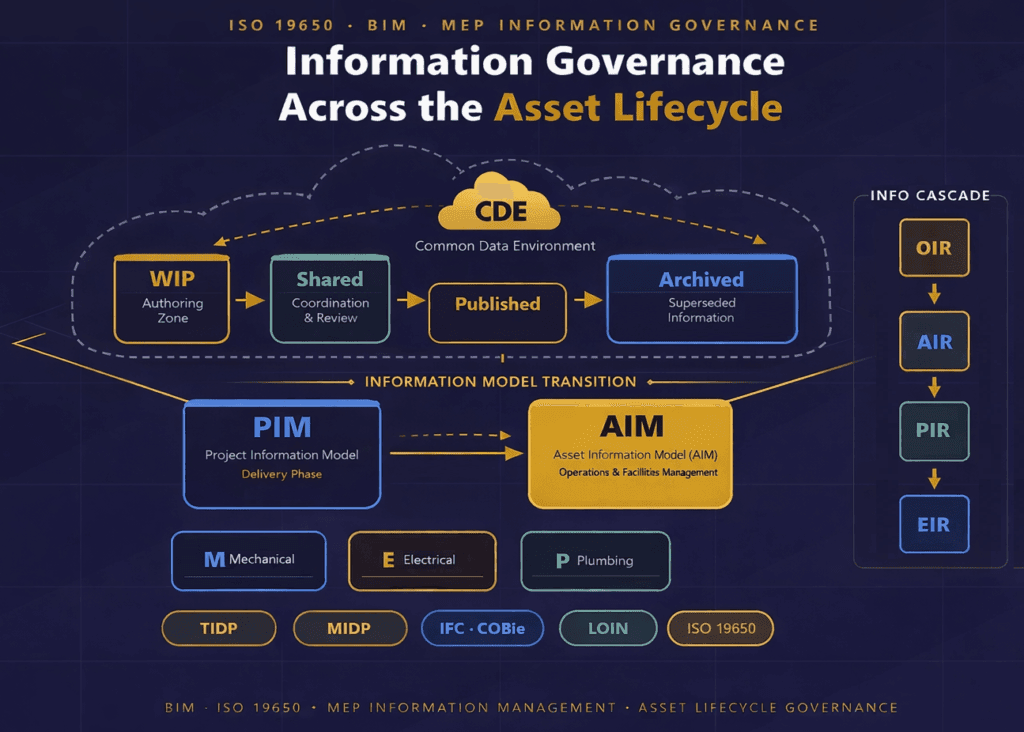
When we talk about BIM in the MEP (Mechanical, Electrical, and Plumbing) world, it is easy to focus on the 3D geometry — the ductwork, pipework, and cable trays. But the real power of BIM is not the model itself. It is the information embedded in, attached to, and delivered through that model. ISO 19650 provides the international framework that governs how this information is created, managed, exchanged, and maintained across the full lifecycle of a built asset — from the first design sketch through decades of operations.
Common Data Environment (CDE)
ISO 19650-2The CDE is the single source of truth for all project information. Think of it as the controlled digital workspace where every model, drawing, document, and data set lives — with full traceability of who did what and when.
Authoring Zone
Authorised Info
In MEP practice this means every HVAC model, electrical schematic, or plumbing layout passes through defined status codes before it can be shared or used by others. Metadata is attached at every stage, revisions are version-controlled, and approvals are formally recorded. For MEP teams coordinating across multiple sub-contractors and design disciplines, the CDE eliminates the costly confusion of working from outdated or unauthorised files.
For an MEP project, a well-implemented CDE reduces design clashes, shortens approval cycles, and creates the paper trail required for both contract compliance and future facilities management. The metadata discipline enforced by the CDE — file naming conventions, status codes, revision histories — is not bureaucracy for its own sake. It is commercial protection.
Defined Information Requirements
ISO 19650-1 & -2ISO 19650 establishes a top-down hierarchy for defining what information is needed, and why, before a single model element is created. This is one of the most transformative shifts from traditional project delivery — the client and asset owner define their information needs upfront, and the project team responds to those needs in a structured, traceable way.
For MEP engineers, this hierarchy is deeply practical. When an EIR specifies that all mechanical equipment must be modelled to LOD 350 with COBie data attached, and that the AIM will use CAFM software requiring a specific data format — that is the EIR and AIR working together. It aligns what is modelled with what is actually needed for operations, preventing the all-too-common scenario of delivering a rich BIM model that the FM team cannot use.
Information Delivery Planning
ISO 19650-2 & -3Knowing what information is needed is only useful if there is a clear plan for when and how it will be delivered. ISO 19650 formalises this through two linked plans:
TIDP (Task Information Delivery Plan) — produced by each appointed party (e.g., the MEP contractor or sub-consultant), defining their specific information deliverables, the responsible individuals, file formats, and milestone dates. This is the team’s commitment to what they will produce.
MIDP (Master Information Delivery Plan) — the lead appointed party consolidates all TIDPs into a single master schedule. This gives the client and project manager a transparent, project-wide view of every information deliverable, mapped to project milestones.
For a complex MEP project — think a large hospital or data centre — the MIDP might coordinate the IFC models from the mechanical engineer, P&ID diagrams from the process engineer, panel schedules from the electrical team, and commissioning data from the specialist contractors, all aligned to a programme with dozens of gateways and handover stages. Without this structure, information arrives late, in inconsistent formats, or simply never arrives at all. With it, each deliverable has an owner, a format, and a deadline that every stakeholder can track.
Project to Asset Model — The Critical Handover
ISO 19650-2 & -3Perhaps the most significant concept in ISO 19650 for MEP is the structured transition from project delivery to asset operation. The standard defines two distinct information models:
Design & Construction
Operations & Maintenance
The PIM is everything produced during design and construction — the coordinated 3D models, construction-phase records, test results, and commissioning reports. The AIM is what the facilities management team actually needs to run the building — asset registers, maintenance schedules, equipment data sheets, O&M manuals, warranties, and spare parts information.
Historically, the disconnect between these two worlds has been a costly industry failure. Rich construction models have been handed over in formats FM teams cannot open, or containing data that was never validated against what was actually installed. ISO 19650-3 specifically addresses the operational phase, ensuring the AIM is populated with verified, structured, and maintainable information. For MEP systems — where a single HVAC unit might have dozens of associated data fields critical to safe and efficient operation — this structured handover is not optional. It is the difference between an asset that can be managed intelligently and one that defaults to reactive maintenance from day one.
Why This Matters for MEP Professionals
ISO 19650 is not a documentation exercise. For MEP teams, it is a framework that directly protects commercial interests, improves coordination, and delivers lasting value to asset owners.
Defined responsibilities and traceable deliverables reduce disputes and protect scope boundaries.
Every model revision, approval, and information exchange is logged — essential for contract compliance and defect liability.
A structured EIR and MIDP makes scope creep visible and provides the evidence needed if additional information requests arise post-contract.
Information produced to ISO 19650 standards is usable beyond handover — supporting capital planning, refurbishment, and ESG reporting for years to come.
Key Takeaways
- The CDE is not just a file storage platform — it is a governed information workflow with defined status codes, metadata requirements, and approval paths that protect all project parties.
- OIR → AIR → PIR → EIR is a top-down information cascade. The client’s strategic needs should drive what the MEP team models, not the other way around.
- TIDPs and MIDPs transform vague BIM deliverable lists into accountable, programme-linked commitments — essential for multi-party MEP projects.
- The PIM-to-AIM transition is where most lifecycle value is lost or gained. Investing in structured handover pays dividends in FM efficiency for the full operational life of the asset.
- ISO 19650-1 provides the concepts and vocabulary. ISO 19650-2 governs the delivery phase. ISO 19650-3 extends the standard into operations — all three are relevant to MEP professionals.
- Discipline, accountability, and governance are not soft concepts — they are the commercial and technical foundations on which ISO 19650 compliance is built.